Hours to Days Conversion: Formula, Chart & Examples 2026
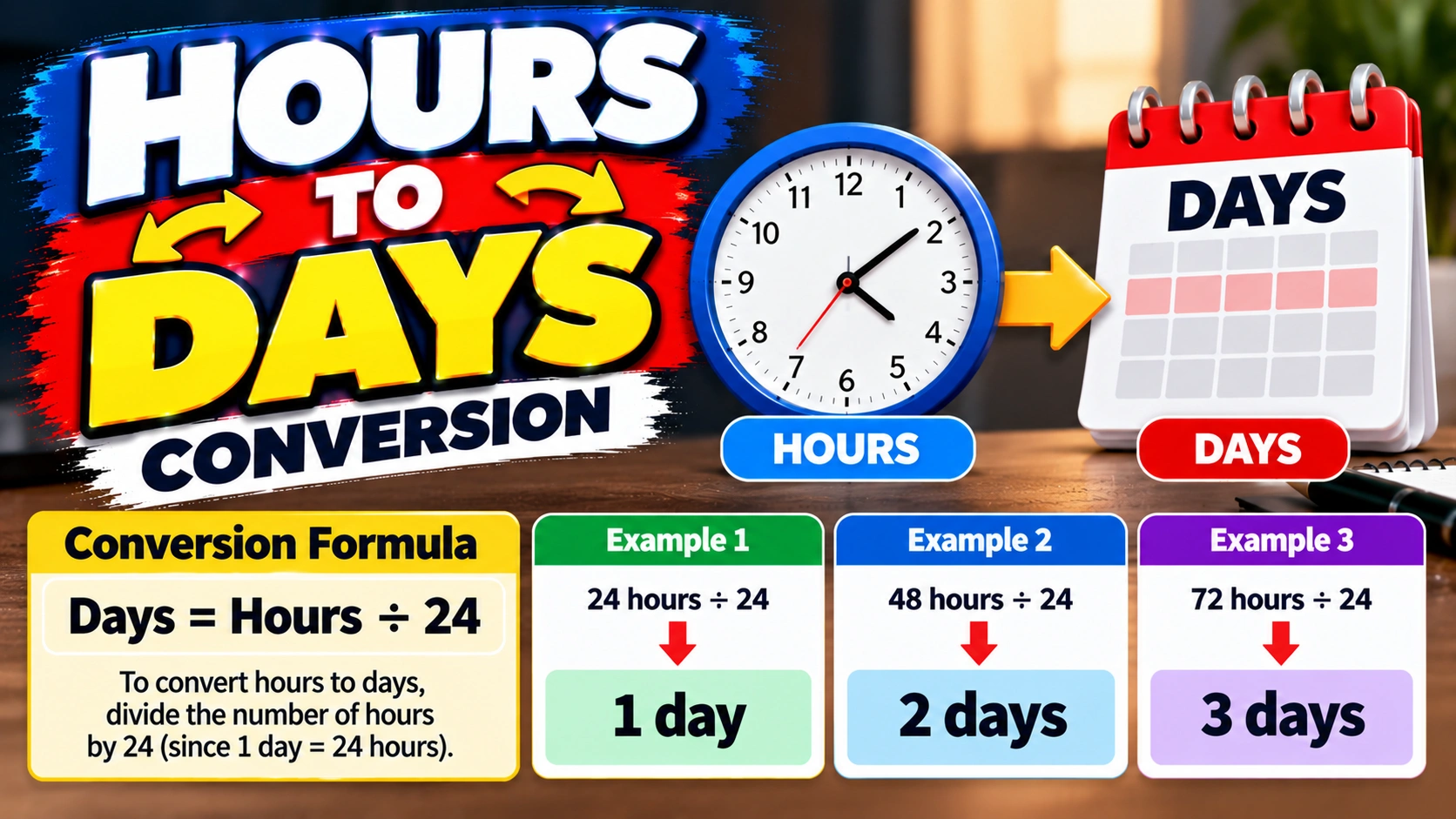
Converting hours to days is a simple calculation that helps you understand time in a more practical way. Whether you’re calculating work schedules, travel durations, project deadlines, study hours, or elapsed time, knowing how to convert hours into days can make planning easier.
The standard conversion is based on a 24-hour day. By dividing the total number of hours by 24, you can determine the equivalent number of days, including fractional days.
This guide explains the hours to days conversion formula, provides a useful reference chart, and shows how to express results in both decimal days and days with remaining hours.
Quick Answer
To convert hours to days, divide the number of hours by 24.
Formula:
\[ \text{Days}=\frac{\text{Hours}}{24} \]
For example:
- 12 hours = 0.5 days
- 24 hours = 1 day
- 48 hours = 2 days
- 72 hours = 3 days
- 168 hours = 7 days
This calculation uses standard 24-hour days, not 8-hour workdays or other scheduling conventions.
Hours to Days Conversion Calculator
Enter the number of hours below to instantly calculate the equivalent number of days and remaining hours.Enter Hours
Decimal Days
3
Days + Hours
3d 0h
72 ÷ 24 = 3 days
Copy Result
Hours to Days Conversion Chart
The following chart shows common hour values and their equivalents in days.
| Hours | Days | Days and Hours |
|---|---|---|
| 1 | 0.0417 | 0 days, 1 hour |
| 2 | 0.0833 | 0 days, 2 hours |
| 3 | 0.125 | 0 days, 3 hours |
| 4 | 0.1667 | 0 days, 4 hours |
| 6 | 0.25 | 0 days, 6 hours |
| 8 | 0.3333 | 0 days, 8 hours |
| 10 | 0.4167 | 0 days, 10 hours |
| 12 | 0.5 | 0 days, 12 hours |
| 18 | 0.75 | 0 days, 18 hours |
| 24 | 1 | 1 day |
| 36 | 1.5 | 1 day, 12 hours |
| 48 | 2 | 2 days |
| 60 | 2.5 | 2 days, 12 hours |
| 72 | 3 | 3 days |
| 96 | 4 | 4 days |
| 120 | 5 | 5 days |
| 144 | 6 | 6 days |
| 168 | 7 | 7 days |
| 240 | 10 | 10 days |
| 336 | 14 | 14 days |
| 720 | 30 | 30 days |
| 1,000 | 41.6667 | 41 days, 16 hours |
Decimal values are rounded to four decimal places where necessary.
How to Convert Hours to Days?
The conversion process involves dividing the total number of hours by the number of hours in one standard day.
Hours to Days Formula
\[ d=\frac{h}{24} \]
Where:
- \(d\) represents the number of days.
- \(h\) represents the total number of hours.
- 24 represents the number of hours in one standard day.
For instance, if you have 240 hours:
\[ 240\div24=10 \]
Therefore, 240 hours equals 10 days.
Converting Hours Into Days and Remaining Hours
Sometimes, expressing time as whole days plus remaining hours is more useful than a decimal.
For example, convert 50 hours into days and hours.
First, divide 50 by 24:
\[ 50\div24=2.08333\ldots \]
There are two complete days in 50 hours.
Next, calculate the remaining hours:
\[ 50-(2\times24)=2 \]
Result: 50 hours = 2 days and 2 hours.
This format is particularly helpful when describing travel durations, countdowns, or project timelines.
Common Hours to Days Conversion Examples
How Many Days Is 8 Hours?
Eight hours equals one-third of a standard day.
\[ 8\div24=0.3333\ldots \]
Therefore, 8 hours is approximately 0.33 days.
In a conventional eight-hour workday schedule, however, eight working hours may count as one workday.
How Many Days Is 12 Hours?
\[ 12\div24=0.5 \]
Twelve hours equals half a day.
How Many Days Is 36 Hours?
\[ 36\div24=1.5 \]
Thirty-six hours equals 1.5 days, or one day and twelve hours.
How Many Days Is 72 Hours?
\[ 72\div24=3 \]
Seventy-two hours equals exactly three standard days.
How Many Days Is 100 Hours?
\[ 100\div24=4.1667 \]
One hundred hours equals approximately 4.17 days, or four days and four hours.
How Many Days Is 1,000 Hours?
\[ 1000\div24=41.6667 \]
One thousand hours equals approximately 41.67 days, or 41 days and 16 hours.
Understanding Decimal Days
When converting hours into days, the result is not always a whole number.
A decimal day represents a fraction of a 24-hour period.
| Decimal Days | Equivalent Hours |
|---|---|
| 0.125 | 3 hours |
| 0.25 | 6 hours |
| 0.375 | 9 hours |
| 0.5 | 12 hours |
| 0.625 | 15 hours |
| 0.75 | 18 hours |
| 0.875 | 21 hours |
| 1.0 | 24 hours |
For example, 0.75 days does not mean 75 hours. It means 75% of one 24-hour day, which equals 18 hours.
To convert decimal days back into hours, multiply the decimal value by 24.
Hours to Days vs. Working Days
A standard day and a working day are not necessarily the same measurement.
A standard day contains 24 hours. A working day represents the number of hours included in a particular work schedule.
For example, under an eight-hour workday arrangement:
| Total Hours | Standard Days | 8-Hour Workdays |
|---|---|---|
| 8 | 0.3333 | 1 |
| 16 | 0.6667 | 2 |
| 24 | 1 | 3 |
| 40 | 1.6667 | 5 |
| 80 | 3.3333 | 10 |
| 160 | 6.6667 | 20 |
The workday column assumes eight working hours per day and does not account for weekends, holidays, or breaks.
For working-day calculations, use:
\[ \text{Workdays}=\frac{\text{Working Hours}}{\text{Hours per Workday}} \]
This distinction matters for payroll calculations, project estimates, employee schedules, and timesheets.
How to Convert Hours to Days in Excel
Microsoft Excel and Google Sheets can perform hours-to-days conversions using simple formulas.
Convert a Number of Hours to Days
If cell A2 contains the total number of hours, enter:
=A2/24For example, if A2 contains 96, the result is 4 days.
Convert Hours to Whole Days
To calculate only the number of complete 24-hour days, use:
=INT(A2/24)If A2 contains 65 hours, the result is 2 complete days.
Find the Remaining Hours
To calculate the hours left after removing complete days, use:
=MOD(A2,24)For 65 hours, the remaining value is 17.
Display Days and Hours Together
For nonnegative whole-number hours, use:
=INT(A2/24)&" days, "&MOD(A2,24)&" hours"If A2 contains 65, the output will be:
2 days, 17 hours
These formulas are useful for time tracking, reporting, scheduling, and project management.
When Is Hours to Days Conversion Useful?
Work and Project Planning
Converting hours into days helps estimate how long a project may take. However, project schedules often use working days rather than continuous 24-hour periods.
For example, a project requiring 40 hours of work could represent five eight-hour workdays, even though 40 hours equals approximately 1.67 standard days.
Travel Duration
Long journeys are easier to understand when expressed in days and hours.
For instance, a 53-hour journey lasts two days and five hours.
Study and Training Schedules
Students and professionals can use conversions to estimate how many study sessions or training days are required.
A 60-hour training program would require ten days if completed in six-hour daily sessions.
Countdowns and Deadlines
Converting remaining hours into days makes deadlines easier to interpret.
For example, 90 hours equals three days and 18 hours.
Equipment Runtime
Runtime measurements for batteries, appliances, servers, and other equipment are often expressed in hours.
A device that operates continuously for 240 hours has a runtime of ten days.
Common Mistakes When Converting Hours to Days
Dividing by 12 Instead of 24
One standard day contains 24 hours, not 12. A 12-hour period represents half a day.
Confusing Workdays With Calendar Days
Eight hours may represent a complete workday, but it equals only one-third of a standard 24-hour day.
Rounding Too Early
Rounding decimal days before completing additional calculations can reduce accuracy.
For example, 10 hours equals approximately 0.4167 days, not exactly 0.42 days.
Misreading Decimal Results
A result of 2.5 days means two days and 12 hours, not two days and five hours.
Multiply the decimal portion by 24 to determine the remaining hours.
Read: How Many Hours Are in a Week
Read: How Many Hours in a Year 2026
Read: Costco Hours Today 2026
Read: USPS Hours 2026
Read: Old Navy Hours 2026
Frequently Asked Questions
How Many Hours Are in One Day?
One standard day contains 24 hours, equivalent to 1,440 minutes or 86,400 seconds.
How Do You Convert Hours to Days Quickly?
Divide the total number of hours by 24. For example, 120 hours divided by 24 equals five days.
Is 48 Hours Equal to Two Days?
Yes. Forty-eight hours equals exactly two standard days because 48 divided by 24 equals 2.
How Many Days Is 72 Hours?
Seventy-two hours equals three days.
How Many Days Is 200 Hours?
Two hundred hours equals approximately 8.33 days, or eight days and eight hours.
How Do You Convert Hours to Days and Hours?
Divide the total hours by 24, take the whole-number portion as complete days, and calculate the remaining hours. For example, 55 hours equals two days and seven hours.
How Many Working Days Are in 40 Hours?
Under an eight-hour workday schedule, 40 working hours equals five workdays. Under a 24-hour conversion, it equals approximately 1.67 days.
Can You Convert Decimal Hours to Days?
Yes. Divide decimal hours by 24. For example, 7.5 hours divided by 24 equals 0.3125 days.
Sources & Verification
The calculations in this guide use the standard time relationships of 24 hours per day and 60 minutes per hour. The conversion chart and worked examples follow these arithmetic relationships.
Workday examples explicitly assume eight working hours per day. Actual working schedules may use different daily hours.
Before You Go
Converting hours to days requires just one calculation: divide the total hours by 24.
For whole-day results, use the integer portion of the quotient and express the remaining time in hours. For work schedules, use the number of hours in the applicable workday instead of automatically dividing by 24.
Keeping these two measurements separate helps ensure accurate calculations for deadlines, travel, work schedules, and everyday time planning.