Is 6 Hours of Sleep Enough? Health Effects and Sleep Needs 2026
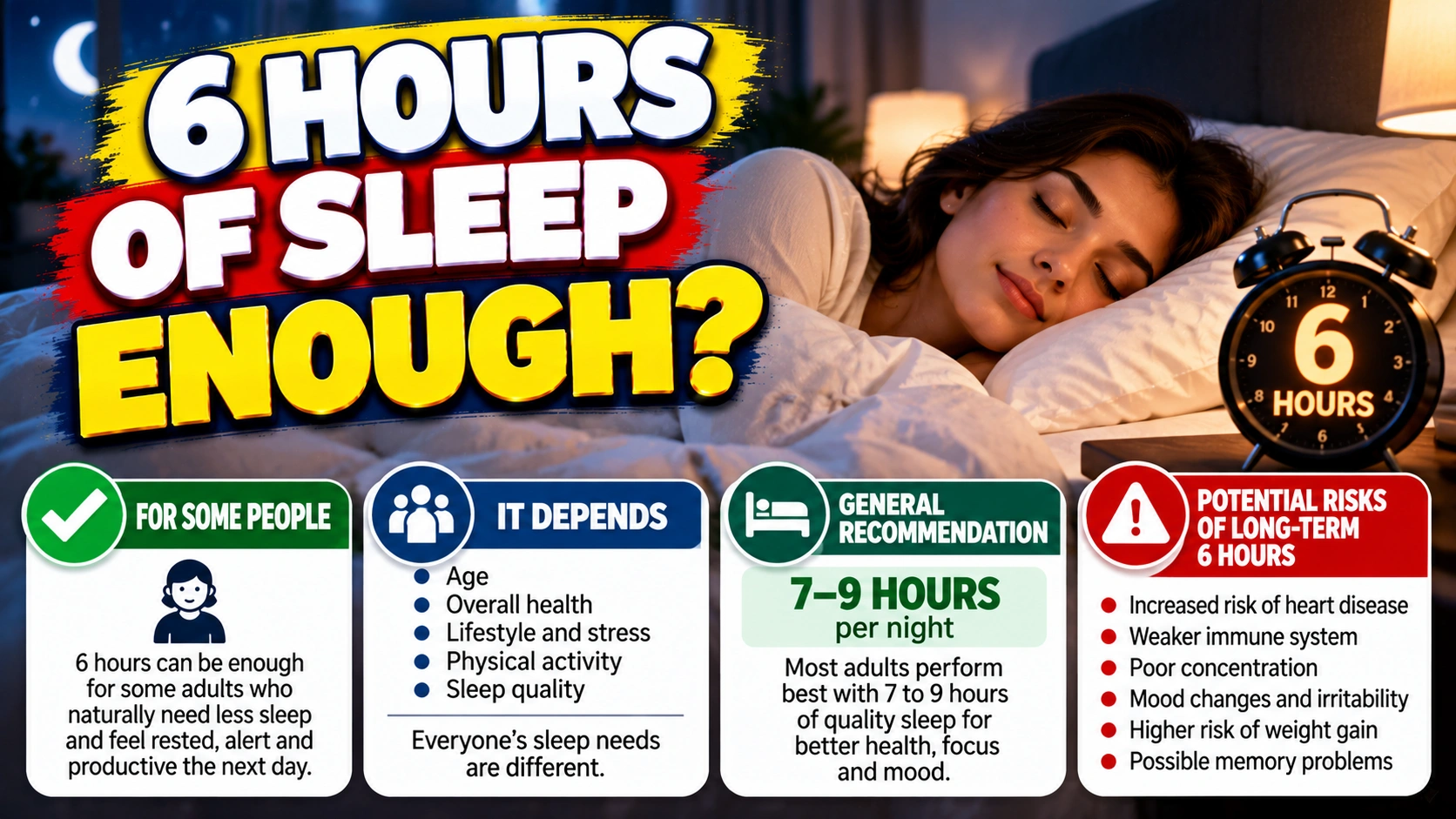
Is 6 hours of sleep enough to feel rested, stay productive, and maintain good health? For most adults, the answer is no. Although six hours may seem manageable, especially when balancing work, family, and personal responsibilities, consistently sleeping this little can affect physical recovery, concentration, mood, and long-term well-being.
Sleep needs differ according to age, health, and individual biology. Some people feel reasonably alert after six hours, but feeling awake does not necessarily mean the body has received sufficient rest.
Understanding recommended sleep duration, the effects of sleep restriction, and the signs of insufficient sleep can help you decide whether your current routine supports your health.
Quick Answer
Six hours of sleep is generally not enough for most healthy adults. The American Academy of Sleep Medicine and Sleep Research Society recommend that adults regularly obtain at least seven hours of sleep, while broader public health guidance commonly recommends seven to nine hours.
Occasionally sleeping six hours is not necessarily harmful, but making it a regular habit can increase sleep debt and contribute to daytime fatigue, reduced attention, and health risks. A small number of people naturally function well on less sleep, but this is uncommon.
How Much Sleep Do You Need at a Glance?
Recommended sleep duration changes throughout life.
| Age Group | Recommended Daily Sleep |
|---|---|
| Newborns (0–3 months) | 14–17 hours |
| Infants (4–12 months) | 12–16 hours, including naps |
| Toddlers (1–2 years) | 11–14 hours, including naps |
| Preschoolers (3–5 years) | 10–13 hours, including naps |
| School-age children (6–12 years) | 9–12 hours |
| Teenagers (13–17 years) | 8–10 hours |
| Adults (18–60 years) | 7 or more hours |
| Adults (61–64 years) | 7–9 hours |
| Adults (65 years and older) | 7–8 hours |
These recommendations reflect established sleep-health guidance, including recommendations from the CDC and sleep-medicine organizations.
Individual requirements can differ, and sleep quality matters alongside total duration.
Is 6 Hours of Sleep Enough for Adults?
For most adults, six hours falls below the recommended minimum.
The body uses sleep to support memory consolidation, immune function, metabolic regulation, tissue recovery, and emotional processing.
When sleep duration becomes consistently restricted, these processes may be affected.
Can You Function Normally on 6 Hours of Sleep?
Some people can complete daily activities after sleeping six hours. They may work, exercise, attend classes, and maintain conversations without obvious difficulties.
However, research on chronic sleep restriction shows that attention and performance can deteriorate even when individuals do not fully recognize how impaired they have become.
Feeling accustomed to six hours does not prove that it meets your biological sleep needs.
Are Some People Naturally Short Sleepers?
Yes. A small number of individuals have genetic characteristics associated with naturally short sleep duration.
These people may feel refreshed and function well despite regularly sleeping less than the typical adult recommendation.
Natural short sleepers are different from people who restrict sleep because of busy schedules, stress, or personal habits.
For most adults, consistently sleeping six hours should not be assumed to be sufficient.
What Happens When You Sleep Only 6 Hours?
The effects depend on how frequently sleep is restricted, individual sleep requirements, and overall health.
An occasional short night may cause temporary tiredness, while repeated restriction can have more significant consequences.
Reduced Concentration and Attention
Insufficient sleep can interfere with sustained attention, reaction time, and decision-making.
You may notice difficulty concentrating during meetings, studying for examinations, or completing tasks that require careful thinking.
These effects are particularly important when driving or operating machinery.
Memory and Learning Difficulties
Sleep supports the processing and consolidation of newly learned information.
When sleep is shortened repeatedly, the brain may have fewer opportunities to complete normal memory-related processes.
This can make studying, remembering details, and learning complicated information more difficult.
Mood Changes and Irritability
Sleep restriction can affect emotional regulation.
People experiencing insufficient sleep may become more irritable, emotionally reactive, or less patient.
Chronic sleep problems are also associated with mental health difficulties, although the relationship is complex and can operate in both directions.
Changes in Appetite and Metabolism
Sleep helps regulate hormones and biological systems involved in hunger, appetite, and glucose metabolism.
Repeatedly obtaining insufficient sleep can disrupt these processes.
Research has linked short sleep duration with an increased risk of metabolic conditions, including type 2 diabetes.
Effects on Immune Function
Adequate sleep supports normal immune-system activity.
Persistent sleep restriction may interfere with immune responses and increase susceptibility to certain infections.
However, the degree of impact differs among individuals.
Is 6 Hours of Sleep Better Than 7 or 8 Hours?
For most adults, seven or eight hours is more consistent with established recommendations than six hours.
| Sleep Duration | General Assessment for Adults |
|---|---|
| 4 hours | Substantially below recommended sleep |
| 5 hours | Insufficient for most adults |
| 6 hours | Below the recommended minimum for most adults |
| 7 hours | Meets the recommended minimum |
| 8 hours | Within the recommended range |
| 9 hours | Within the commonly recommended adult range |
| 10 hours | May be appropriate in some circumstances, including recovery from sleep loss |
This comparison is not a guarantee of how any particular person will feel or perform.
6 Hours vs. 7 Hours of Sleep
An additional hour can make a meaningful difference for someone who regularly sleeps less than their body requires.
Seven hours meets the minimum recommended duration for most adults, although some need more.
6 Hours vs. 8 Hours of Sleep
Eight hours allows more sleep opportunity and falls comfortably within the recommended adult range.
For someone whose natural requirement is eight hours, regularly sleeping six hours creates a recurring shortfall.
Does Sleep Quality Matter More Than Duration?
Both matter.
Six hours of uninterrupted sleep may feel better than eight hours of severely fragmented sleep, but that does not establish that six hours is sufficient.
Healthy sleep involves appropriate duration, continuity, timing, and regularity.
Good sleep quality cannot reliably compensate for chronically inadequate sleep duration.
Can You Survive on 6 Hours of Sleep Every Night?
Yes, people can continue living and performing everyday activities while regularly sleeping six hours.
However, surviving on a sleep schedule is not the same as maintaining optimal health.
Long-term observational research associates habitual short sleep with increased risks of several health problems, including:
- Cardiovascular disease
- High blood pressure
- Type 2 diabetes
- Obesity
- Depression
- Impaired cognitive functioning
These associations do not prove that sleeping six hours directly causes every condition. Other factors, including existing illnesses, lifestyle, and sleep disorders, can influence the relationship.
Nevertheless, regularly obtaining less sleep than recommended is a recognized health concern.
Is 6 Hours of Sleep Enough for Different People?
Sleep requirements vary with age, activity, and individual circumstances.
For Students
Six hours is generally insufficient for teenagers and may also be inadequate for college students.
Sleep plays an important role in learning, memory, attention, and emotional regulation.
Students who regularly sacrifice sleep to study may experience reduced learning efficiency and poorer concentration.
For People Who Exercise
Physical activity increases the importance of adequate recovery.
Sleep supports muscle repair, adaptation to training, and overall athletic performance.
Six hours may leave some physically active adults insufficiently recovered, especially during demanding training periods.
For Older Adults
Older adults sometimes experience changes in sleep timing and sleep continuity.
However, aging does not eliminate the need for sufficient sleep.
Adults aged 65 and older are generally advised to obtain seven to eight hours daily.
For Busy Professionals
Work demands and irregular schedules can make adequate sleep difficult.
However, regularly shortening sleep to create more working hours can impair attention, judgment, and productivity.
Protecting sleep time is an important part of maintaining performance.
What Are the Signs That 6 Hours of Sleep Is Not Enough?
Your daytime functioning can provide useful clues about whether you are getting sufficient rest.
Common signs include:
- Feeling tired shortly after waking
- Struggling to remain alert during quiet activities
- Needing excessive caffeine to stay awake
- Having difficulty concentrating
- Becoming unusually irritable
- Feeling sleepy while driving
- Sleeping much longer on days off
- Frequently falling asleep unintentionally
These symptoms are not specific to insufficient sleep. They can also occur with sleep apnea, medication effects, medical conditions, and other sleep disorders.
Persistent symptoms deserve medical evaluation.
Can You Train Your Body to Need Only 6 Hours of Sleep?
There is no reliable evidence that most people can train themselves to require substantially less sleep than their biological needs.
People may become accustomed to a shorter schedule and report feeling less sleepy over time.
However, objective performance may remain impaired.
Reducing time in bed does not necessarily reduce the amount of sleep the body needs.
For someone regularly sleeping six hours, increasing sleep opportunity is generally more appropriate than attempting to adapt to chronic restriction.
Does Taking a Nap Make 6 Hours of Sleep Enough?
Napping can improve alertness and reduce some immediate effects of sleepiness.
However, naps are not a complete replacement for sufficient nighttime sleep.
Benefits of Short Naps
A short daytime nap may help with:
- Temporary alertness
- Attention
- Mood
- Short-term performance
A nap of approximately 20–30 minutes is often practical for avoiding prolonged grogginess, although responses vary.
Can You Combine 6 Hours of Nighttime Sleep With Naps?
Total sleep over 24 hours matters, and split sleep schedules can work in certain circumstances.
However, whether six nighttime hours plus a nap is sufficient depends on the individual’s total sleep duration, sleep quality, and schedule.
For most adults, obtaining adequate, consistent nighttime sleep remains the simplest approach.
How to Get Better Sleep Every Night
Improving sleep usually requires attention to both daily habits and the sleep environment.
Maintain a Consistent Sleep Schedule
Try to go to bed and wake up at similar times each day.
Regular timing helps support the body’s circadian rhythm.
Allow Enough Time for Sleep
If you need eight hours of actual sleep, your time in bed may need to be somewhat longer to account for falling asleep and brief awakenings.
Plan your bedtime around your required wake-up time rather than relying entirely on how tired you feel.
Limit Caffeine Later in the Day
Caffeine can remain active for several hours and interfere with falling asleep.
People sensitive to caffeine may benefit from avoiding it during the afternoon and evening.
Reduce Bright Light Before Bed
Bright light, including light from electronic devices, can affect circadian timing.
Reducing unnecessary bright light before bedtime may make it easier to maintain a regular sleep routine.
Create a Comfortable Sleeping Environment
A quiet, dark, and comfortably cool bedroom can support sleep.
Consider reducing noise, limiting disruptive light, and choosing comfortable bedding.
Exercise Regularly
Regular physical activity is associated with better sleep quality.
However, exercise timing should reflect personal tolerance, especially if vigorous activity close to bedtime makes falling asleep difficult.
Avoid Using Alcohol as a Sleep Aid
Alcohol may initially cause drowsiness, but it can disrupt sleep later in the night.
It is not a reliable way to improve restorative sleep.
How to Move From 6 Hours to 8 Hours of Sleep
If you currently sleep six hours and want to increase your sleep duration, a gradual adjustment may be easier to maintain.
Start by identifying your regular wake-up time and the amount of sleep you want to obtain.
For example, someone who wakes at 7:00 AM and wants eight hours of sleep needs to be asleep around 11:00 PM.
Because falling asleep takes time, bedtime may need to be earlier.
Consider moving your bedtime earlier in small increments while maintaining a consistent morning wake-up time.
Avoid spending excessive time awake in bed. If you consistently struggle to fall asleep, addressing the underlying sleep problem is more useful than simply extending bedtime.
When Should You Speak to a Healthcare Professional?
Consider seeking medical advice if you:
- Regularly feel exhausted despite adequate time in bed
- Snore loudly or experience breathing interruptions during sleep
- Have persistent difficulty falling or staying asleep
- Frequently fall asleep unintentionally during the day
- Experience significant daytime sleepiness that affects work or safety
- Cannot increase sleep duration despite consistently trying
A healthcare professional can help identify insomnia, sleep apnea, circadian rhythm disorders, or other conditions that may affect sleep.
If you feel sleepy while driving, stop driving and address the immediate safety risk.
Read: Walmart Pharmacy Hours 2026
Read: Publix Pharmacy Hours 2026
Read: Safeway Pharmacy Hours 2026
Read: H-E-B Pharmacy Hours 2026
Read: Meijer Pharmacy Hours 2026
Frequently Asked Questions
Is 6 Hours of Sleep Enough for One Night?
An occasional six-hour night is not necessarily a major health concern for an otherwise healthy adult. You may experience temporary fatigue or reduced concentration, but one short night is different from chronic sleep restriction.
Is 6 Hours of Sleep Enough if I Feel Fine?
Not necessarily. People can underestimate the effects of insufficient sleep. Feeling alert is useful information, but it does not prove that six hours meets your biological needs.
Is 6 Hours of Sleep Enough for a 20-Year-Old?
Most 20-year-olds should aim for at least seven hours, with seven to nine hours being a common recommended range for adults.
Is 6 Hours of Sleep Enough for Muscle Growth?
Six hours may be insufficient for optimal recovery in many physically active adults. Adequate sleep supports muscle recovery, training adaptation, and overall performance.
Can 6 Hours of Sleep Cause Weight Gain?
Short sleep is associated with changes in appetite regulation and an increased risk of weight gain. However, body weight is influenced by many factors, and six hours of sleep does not automatically cause weight gain.
Is 6 Hours of Sleep Enough With a 30-Minute Nap?
A short nap can improve alertness, but six and a half total hours remains below the usual adult recommendation. Individual sleep needs and nap effectiveness vary.
Why Do I Feel Better After 6 Hours Than 8 Hours?
Wake-up timing, sleep inertia, sleep continuity, and circadian rhythm can influence how you feel immediately after waking. Feeling better after six hours on one occasion does not establish that less sleep is healthier for you.
How Long Does It Take to Recover From Sleep Deprivation?
Recovery depends on the severity and duration of sleep loss. Some symptoms improve after one or more nights of adequate sleep, while certain performance effects may take longer to normalize.
Sources & Verification
The sleep-duration recommendations and health guidance in this article are based on established research and guidance from the following organizations and scientific literature:
- Centers for Disease Control and Prevention (CDC): Recommended sleep duration by age and the importance of sufficient sleep.
- American Academy of Sleep Medicine (AASM): Adult sleep-duration consensus recommendations.
- Sleep Research Society (SRS): Scientific recommendations concerning healthy adult sleep duration.
- National Institutes of Health (NIH): Sleep deficiency, health effects, and sleep-health education.
- Van Dongen and colleagues, Sleep (2003): Controlled research examining the cumulative cognitive effects of chronic sleep restriction.
These sources provide general sleep-health guidance rather than individualized medical advice. The recommendations are not based on a personal sleep assessment.
Before You Go
So, is 6 hours of sleep enough? For most adults, six hours is less than the recommended amount, even if they feel reasonably functional during the day.
Occasionally sleeping six hours is different from making it a permanent routine. Consistently obtaining adequate sleep supports concentration, physical recovery, emotional regulation, and long-term health.
Aim for at least seven hours of sleep, with seven to nine hours being appropriate for many adults. If you remain tired despite sufficient sleep opportunity, consider discussing your symptoms with a healthcare professional.